As I worked my way through my recent series on How to Find Faith, I found myself distinguishing between "belief" and "faith". People often use them interchangably but they are worlds apart.
To believe is merely an intellectual exercise. You can believe in all kinds of things and not have it impact your life. For example, I've believed in George Washington all my life, but George has never made a difference in my life. The same is true for people who believe in Jesus. Simply believing in the fact that he lived on earth and even was/is the Son of God is meaningless if you haven't allowed that belief to impact you. Faith begins where belief ends.
To believe in Jesus is rational. But putting faith in Jesus is irrational! It doesn't make sense to the logical mind. The person who puts faith in Jesus risks giving up control of their daily life to entrust it to an invisible God. Think of two people who "believe" in airplanes yet one never risks flying while the other does. The person who flies has "faith" in airplanes. They have so much confidence in airplanes that they are willing to risk their life to ride one. And since they are willing to risk giving up control and riding an airplane, their life is dramatically impacted. They can be across the world in less than a day to see things that they would never see otherwise.
So it is with faith in God. To "believe" in God means nothing unless you are willing to risk your life to his guidance and yield yourself to His power to live a new life. Don't kid yourself into thinking that believing is enough. God asks for more than your belief. The Bible tells us that God's people live by faith. For more on this read sermons 8 & 9 of my series, How to Find Faith in a World of Doubt.
Wednesday, November 02, 2005


Wednesday, October 26, 2005
How to Approach Reading the Bible (Part 5)
Here are my last two thoughts on how to approach the Bible...
9. Read the Bible to be more, live more and do more, not just know more.
The Bible is such a fascinating book that it’s easy to read it and never apply it. I was talking to someone yesterday about end time prophecy. They wondered if I ever taught on it and I said “No, I don’t. I purposefully avoid it because it’s too easy for people to get caught up in the end times discussion and forget about how God wants them to live their life today.”
Some times we forget that the goal of our Bible reading should be to know God, to know our own heart, to live life more fully and to learn how to love others. It shouldn't be a contest to see who can quote the most Bible verses or who can read the most pages.
10. Approach the Bible often.
Don’t let it collect dust. Two years ago I spoke on the importance of reading the Bible at church and one of my members decided that he knew a lot about a many things but he had never read the Bible through from cover to cover. So he decided he was going to do just that. Now, two years later, he is just finishing the last few pages of Revelation, the last book in the Bible. He said that he was surprised how enjoyable his daily reading was. He could hardly wait to see what was going to happen next in each story. He kept notes of key themes and verses and he reduced it to three pages of notes to help him remember the most important things that God showed him in his reading. I recommend the same to you. You don't have to believe that the Bible is divine to get anything out of it. Just read it. You might be surprised to hear God speaking to you through it.
9. Read the Bible to be more, live more and do more, not just know more.
The Bible is such a fascinating book that it’s easy to read it and never apply it. I was talking to someone yesterday about end time prophecy. They wondered if I ever taught on it and I said “No, I don’t. I purposefully avoid it because it’s too easy for people to get caught up in the end times discussion and forget about how God wants them to live their life today.”
Some times we forget that the goal of our Bible reading should be to know God, to know our own heart, to live life more fully and to learn how to love others. It shouldn't be a contest to see who can quote the most Bible verses or who can read the most pages.
10. Approach the Bible often.
Don’t let it collect dust. Two years ago I spoke on the importance of reading the Bible at church and one of my members decided that he knew a lot about a many things but he had never read the Bible through from cover to cover. So he decided he was going to do just that. Now, two years later, he is just finishing the last few pages of Revelation, the last book in the Bible. He said that he was surprised how enjoyable his daily reading was. He could hardly wait to see what was going to happen next in each story. He kept notes of key themes and verses and he reduced it to three pages of notes to help him remember the most important things that God showed him in his reading. I recommend the same to you. You don't have to believe that the Bible is divine to get anything out of it. Just read it. You might be surprised to hear God speaking to you through it.
Sunday, October 23, 2005
How to Approach Reading the Bible (Part 4)
7. Know the Big Story before you interpret the small ones.
If you don’t know the big picture in the Bible, you will tend to interpret verses according to your own biases. For example, the overall story has to do with God including people. So if you find yourself always reading the Bible in a way that judges and excludes people, then you are probably missing the point.
8. Read the Bible with others, not just by yourself.
The Bible wasn’t written for individuals. It was written for the community of faith. I’m not saying that we shouldn’t have our own Bible or that we should never read it alone but we need to understand that God wants to speak to us as a community of believers, not a group of individuals. Most of the New Testament is letters written to churches not individuals. So I encourage you to read your Bible but get together with other believers to read it with them as well as.
If you don’t know the big picture in the Bible, you will tend to interpret verses according to your own biases. For example, the overall story has to do with God including people. So if you find yourself always reading the Bible in a way that judges and excludes people, then you are probably missing the point.
8. Read the Bible with others, not just by yourself.
The Bible wasn’t written for individuals. It was written for the community of faith. I’m not saying that we shouldn’t have our own Bible or that we should never read it alone but we need to understand that God wants to speak to us as a community of believers, not a group of individuals. Most of the New Testament is letters written to churches not individuals. So I encourage you to read your Bible but get together with other believers to read it with them as well as.
Thursday, October 20, 2005
How to Approach Reading the Bible (Part 3)
5. Read the Bible like a story book, not a cookbook.
What I mean by this is that our lives are stories, not recipes. We have a tendency to want to make everything simple. We want to read about three easy steps to health, wealth and success in life – add a cup of this and a pinch of that and presto! – the results you wanted. But the stories aren’t like that in the Bible and they aren’t like that in our lives either.
Have you noticed? Marriages don’t always work. Children don’t always turn out the way you planned. We don’t always get the perfect job that solves all of our financial problems. But what’s true of every story in the Bible is that God is there. God is there in the midst of the pain and the problems. And God wants us to know that that can be our story too. If we will start to acknowledge God in our presence then our circumstances may not change but our sense of turmoil will. With our hand in God’s hand, suddenly life is not so threatening and we can see more clearly and breathe more easily.
6. Let the Bible conquer you instead of you trying to conquer it.
Part of approaching the Bible with humility is understanding that no matter how much you read or how much you know, it will always be bigger than you are. You can’t master the Bible like you can some other book. The Bible is too deep to master. So rather than try to master the Bible, why not let it master you? Let it transform you by doing what it says and not just reading what it says. I bet there are a lot of people in Bible schools and seminaries today who have the wrong motivation in their study. They want to become “experts of the Bible” but God is simply calling them to become “experts at life” and wants them to read the Bible as their guidebook.
What I mean by this is that our lives are stories, not recipes. We have a tendency to want to make everything simple. We want to read about three easy steps to health, wealth and success in life – add a cup of this and a pinch of that and presto! – the results you wanted. But the stories aren’t like that in the Bible and they aren’t like that in our lives either.
Have you noticed? Marriages don’t always work. Children don’t always turn out the way you planned. We don’t always get the perfect job that solves all of our financial problems. But what’s true of every story in the Bible is that God is there. God is there in the midst of the pain and the problems. And God wants us to know that that can be our story too. If we will start to acknowledge God in our presence then our circumstances may not change but our sense of turmoil will. With our hand in God’s hand, suddenly life is not so threatening and we can see more clearly and breathe more easily.
6. Let the Bible conquer you instead of you trying to conquer it.
Part of approaching the Bible with humility is understanding that no matter how much you read or how much you know, it will always be bigger than you are. You can’t master the Bible like you can some other book. The Bible is too deep to master. So rather than try to master the Bible, why not let it master you? Let it transform you by doing what it says and not just reading what it says. I bet there are a lot of people in Bible schools and seminaries today who have the wrong motivation in their study. They want to become “experts of the Bible” but God is simply calling them to become “experts at life” and wants them to read the Bible as their guidebook.
Wednesday, October 19, 2005
How to Approach Reading the Bible (Part 2)
I make attempts at playing golf. People in the know tell me that how you approach the ball has alot to do with how well you will hit it. I'm not talking about how you walk up to the ball but how you position your body in relation to the ball...the distance between you and the ball, where the ball is in relation to your left or right foot, your posture, etc.
I think the same can be said about approaching the Bible. What you get out of it has a lot to do with the attitudes that you bring to it. Here are my next two points (out of ten)...
3. Read for quality, not quantity.
I think it’s great when people get ambitious and decide to read the whole Bible in a year. Or they decide to read a chapter a day. That can be good to give you the big picture of what’s going on. But it can also make you miss the point of why you are reading the Bible in the first place. Our goal is to hear from God so don’t be afraid to just read a few words or sentences and meditate on them until they become relevant to your life. Let the words be a mirror, giving you insight into your own heart and then ask God what he wants to tell you about what you see. (Hint: God's voice is encouraging, not condemning.)
4. Read for questions, not just answers.
Some times people say things like: The Bible will answer all your questions about God and life. No it won’t. If it could then it would only prove that either the Bible is false or God doesn’t exist! Nothing can answer all your questions about God because God is too big to be reduced to words. So, when you read the Bible, expect to have questions and don’t worry if you don’t get them answered right away. Questions stimulate us to want to know more about God while too many answers tend to make us think that we’ve got God all figured out.
part three to follow...
I think the same can be said about approaching the Bible. What you get out of it has a lot to do with the attitudes that you bring to it. Here are my next two points (out of ten)...
3. Read for quality, not quantity.
I think it’s great when people get ambitious and decide to read the whole Bible in a year. Or they decide to read a chapter a day. That can be good to give you the big picture of what’s going on. But it can also make you miss the point of why you are reading the Bible in the first place. Our goal is to hear from God so don’t be afraid to just read a few words or sentences and meditate on them until they become relevant to your life. Let the words be a mirror, giving you insight into your own heart and then ask God what he wants to tell you about what you see. (Hint: God's voice is encouraging, not condemning.)
4. Read for questions, not just answers.
Some times people say things like: The Bible will answer all your questions about God and life. No it won’t. If it could then it would only prove that either the Bible is false or God doesn’t exist! Nothing can answer all your questions about God because God is too big to be reduced to words. So, when you read the Bible, expect to have questions and don’t worry if you don’t get them answered right away. Questions stimulate us to want to know more about God while too many answers tend to make us think that we’ve got God all figured out.
part three to follow...
Monday, October 17, 2005
How to Approach Reading the Bible
The Bible has taken a lot of flack over the years for not being all that people have made it out to be but I think it's greatest claim to truth is how it speaks to an individuals heart. You see, the Bible is a book of stories, stories of people who walk with God or without God. When we compare our story to these stories we often find our heart resonating. We go "Hey, this happened 3,000 years ago but it's happening in my life today in the same way." That's because we are all human and as humans we share a lot of things in common. This resonance gives the Bible a lot of credibility to me and I think it will to you too if you just read it.
I shared seven examples of how the Bible rings true to me in my message yesterday, Can the Bible Help Me To Find Faith? I'll let you click the link to read about that but I'll share here, Ten Ways to Approach Reading the Bible, also in my sermon (loosely adapted from Brian McLaren's book Adventures in Missing the Point).
1. Come with an open mind and a humble heart.
Too often people come to the Bible with an attitude of unbelief or an agenda to prove. They come doubting everything or just wanting to justify what they already believe. But you need to check all that at the door and simply ask God to show you what is true. You can’t hear from God when you’ve got earplugs in! So come like an innocent child with fresh ears to hear what God has to say to you.
2. Understand and appreciate the literature forms.
This has to do with interpreting the Bible literally versus figuratively. Some times we are supposed to take the Bible literally and you need to learn when that is. Other times you need to take it figuratively so you need to understand the cues to know which is which. You see, the Bible uses a variety of ways to communicate its message. Some times it uses poetry, some times it tells a story, and sometimes it just gives commands. Sometimes the writer exaggerates to make his point. Some times he uses understatement or even sarcasm. So just be aware of these styles when you read.
more points to come...
I shared seven examples of how the Bible rings true to me in my message yesterday, Can the Bible Help Me To Find Faith? I'll let you click the link to read about that but I'll share here, Ten Ways to Approach Reading the Bible, also in my sermon (loosely adapted from Brian McLaren's book Adventures in Missing the Point).
1. Come with an open mind and a humble heart.
Too often people come to the Bible with an attitude of unbelief or an agenda to prove. They come doubting everything or just wanting to justify what they already believe. But you need to check all that at the door and simply ask God to show you what is true. You can’t hear from God when you’ve got earplugs in! So come like an innocent child with fresh ears to hear what God has to say to you.
2. Understand and appreciate the literature forms.
This has to do with interpreting the Bible literally versus figuratively. Some times we are supposed to take the Bible literally and you need to learn when that is. Other times you need to take it figuratively so you need to understand the cues to know which is which. You see, the Bible uses a variety of ways to communicate its message. Some times it uses poetry, some times it tells a story, and sometimes it just gives commands. Sometimes the writer exaggerates to make his point. Some times he uses understatement or even sarcasm. So just be aware of these styles when you read.
more points to come...
Monday, October 10, 2005
Is there one way, or many ways, to God?
I came across a great Hoobastank song that expresses frustration at people who are so narrow minded as to believe that there is only one way to God. Here are some of the lyrics for "Same Direction"...
...everyone thinks they're right
And nobody thinks that there just might
Be more than one road to our final destination
So why does there only have to be one correct philosophy?
I don't want to go and follow you just to end up like one of them
And why are you always telling me what you want me to believe?
I'd like to think that i can go my own way and meet you in the end.
I think the song embodies the belief of many people today. But are they right? I know it sounds good. I addressed this in my Sunday message, Faith Options...Are there many ways to God? Let me share four points that I closed with from Brian McLaren's book, Finding Faith. I really think they bring a good balance to the whole discussion...
- Honor the truth wherever you find it. Jesus may be the way to connect with God, but that doesn't mean that other religions don't have any truth. It's important that we have the honesty to admit it.
- Honor the glory wherever you find it. When we find examples of dedication, faith, compassion, sacrifice or beauty, it doesn't matter what faith the person has. These qualities are good regardless of the faith. The fact that the person is not Christian doesn't invalidate the virtue.
- Honor people, even when you disagree. When we honor people, we honor God, even when people don't agree with us.
- It's okay to not know. The big question that people often have about Christianity is, "What happens to people who never hear about Jesus?" Many people have assumed that they automatically go to hell. That answer has turned people away from the faith. They don't want to be a part of that kind of religion. But the truth is we don't know. The Bible doesn't say. It's pure speculation, and personally, I think it's poor speculation. It's not consistent with what we know about God. But I won't speculate the other way either. That's the point - it's okay to not know. I like what Abraham said, "Won't the Judge of the whole earth do justly?" I rest in that.
Tuesday, October 04, 2005
Am I Seeker Sensitive?
I had a conversation with some folks recently about my philosophy of preaching and I thought it might interest some people, at least who attend Cedarbrook. It got started as we talked about whether Cedarbrook is a "seeker" church or "seeker-sensitive".
You might not know this but churches often categorize themselves as "believer focused" (having the committed Christian in mind), "seeker focused" (having the spiritual seeker in mind), and "seeker sensitive" (having the believer in mind but also sensitive to the fact that there are seekers in the audience). Many people would say that Cedarbrook is a seeker church, but as is often the case, I reject being labeled.
In regard to preaching, my goal is to address the needs of seekers and believers because we are all human and as humans we share common needs. I don't like making distinctions because I think we have much more in common as just plain people than we care to admit. We all have fears, we all get angry, we all long for God (at least at some level), etc. etc. Maybe the best term for me is "people-sensitive".
While I'm teaching the seeker the basics, I'm trying to re-teach the believer because I don't think they necessarily see things from a biblical viewpoint. Many people learned about God, Jesus and faith through a very "works" oriented grid tinged with judgmentalism. I try to teach people how to think through a grid of grace. And I try to teach them how to do what they believe, not to just know what they believe.
You might not know this but churches often categorize themselves as "believer focused" (having the committed Christian in mind), "seeker focused" (having the spiritual seeker in mind), and "seeker sensitive" (having the believer in mind but also sensitive to the fact that there are seekers in the audience). Many people would say that Cedarbrook is a seeker church, but as is often the case, I reject being labeled.
In regard to preaching, my goal is to address the needs of seekers and believers because we are all human and as humans we share common needs. I don't like making distinctions because I think we have much more in common as just plain people than we care to admit. We all have fears, we all get angry, we all long for God (at least at some level), etc. etc. Maybe the best term for me is "people-sensitive".
While I'm teaching the seeker the basics, I'm trying to re-teach the believer because I don't think they necessarily see things from a biblical viewpoint. Many people learned about God, Jesus and faith through a very "works" oriented grid tinged with judgmentalism. I try to teach people how to think through a grid of grace. And I try to teach them how to do what they believe, not to just know what they believe.
Some people may not be used to how practical I am and confuse that with being seeker oriented. Maybe they think that believers should be taught more about what the Bible says and not spend so much time on the application - that the application is obvious. But the application isn't obvious. That's why believers get accused of being hypocrites. We talk a good game but we don't live it. More on this later...
Monday, October 03, 2005
Reflecting on Intelligient Design
I graduated from college with a degree in Biology. So looking at faith with a scientific eye was not foreign to me. I became a Christian in college and so I read a lot about the creation vs. evolution debate back then. But eventually I grew tired of it. There was so much to know and everyone was convinced that the other side was stupid. It was a negative conversation, so I dropped it. I haven't read or talked much about it. When someone raised the issue I often deflected it by recommending a book, but not wanting to get sucked into the debate myself.
But my recent sermon series (How to Find Faith in a World of Doubt) led me to address the need for evidence for God. I read two excellent books, The Case for a Creator and More Than Meets the Eye. I was surprised how science had swung so much in the past thirty years to support faith rather than contradict it. I admit I gave these books a quick read, but I came up with six observations that I think can be converted into evidence for God if someone chose to believe that God was behind these observations. Here they are;
But my recent sermon series (How to Find Faith in a World of Doubt) led me to address the need for evidence for God. I read two excellent books, The Case for a Creator and More Than Meets the Eye. I was surprised how science had swung so much in the past thirty years to support faith rather than contradict it. I admit I gave these books a quick read, but I came up with six observations that I think can be converted into evidence for God if someone chose to believe that God was behind these observations. Here they are;
- The universe was created. It didn't always exist. Einstein's theory tells us that there was a starting point to the universe. And it came from nothing.
- The earth is located in a life-friendly pocket of a life-threatening universe. What are the odds of earth being so perfectly located in a place that supports life? (Not to mention the coincidence that life was created in the first place).
- Many variables have converged to make life possible. Science has proven that there is an incredible number of variables that have been calibrated to infintisimal decimal points to sustain life. It's as if they have all lined up on a razor's edge - if they were to tip in one direction or another, life would not be sustainable on earth.
- Irreducibly complex entities exist. Entities like the human cell or the eyeball need to have every component in place to exist. So how does an entity like this evolve, one mutation at a time?
- DNA is a program for life. There are three billion pairings in the human genome. It looks very much like a computer code. We would never suggest that a computer program spontaneously evolved over time yet we are comfortable to say that this happened in DNA.
- Human beings have consciousness. Why? How? We take our ability to reflect and observe for granted yet it is unique to humans, at least at the sophisticated level that it is.
There is an eight page summary of The Case for a Creator on our website. But the book itself is a great read if you have the time. (By the way, for those of you in the know, the writer of the summary made a mistake when he referred to the type of galaxy that we are in.)
Saturday, September 24, 2005
The Role of Doubt in Finding Faith
Doubt is an interesting topic in the search for faith. It's often seen as the antithesis of faith but it's not. Apathy is. If you truly didn't believe, you wouldn't even care about God. But doubt shows that you do believe, you are just struggling with your belief.
The truth is that we often doubt what we believe just like we argue with those we love. If we didn't love them, we wouldn't bother to argue. In the same way, if we didn't believe at some level, we'd have no reason to doubt. So doubt doesn't prove you don't believe in God any more than an argument with my wife proves that I don't love her.
Many of us hate conflict because we don't like to argue. We'll avoid it like the plague, just trying to act like everything is okay when it's really not. It dawned on me a number of years ago that conflict can actually produce intimacy in a relationship if I'll let it. You see, it's through disagreeing with someone and talking about that disagreement that I come to know them better. They get to know me better as well. Talking through a conflict will help me to draw closer to my wife or child or friend because we'll both appreciate things about each other that we never knew before.
It's the same with doubt. We are often so ashamed of our doubt (regarding God) that we don't want to admit it to anyone, even ourselves. We just quietly nod in agreement when God is discussed and hope that our nagging doubt gets resolved on its own.
But doubt can actually be good for our faith. Healthy doubt tells us that there's something wrong in our thinking that we need to take a look at. Doubt is really internal conflict. And, if you are willing to face it, it will produce a greater sense of intimacy with God. So don't fear your doubt, face it, and invite God into the process of resolving your doubt. It's not something that you have to suffer alone. He WANTS to help you sort everything out.
The truth is that we often doubt what we believe just like we argue with those we love. If we didn't love them, we wouldn't bother to argue. In the same way, if we didn't believe at some level, we'd have no reason to doubt. So doubt doesn't prove you don't believe in God any more than an argument with my wife proves that I don't love her.
Many of us hate conflict because we don't like to argue. We'll avoid it like the plague, just trying to act like everything is okay when it's really not. It dawned on me a number of years ago that conflict can actually produce intimacy in a relationship if I'll let it. You see, it's through disagreeing with someone and talking about that disagreement that I come to know them better. They get to know me better as well. Talking through a conflict will help me to draw closer to my wife or child or friend because we'll both appreciate things about each other that we never knew before.
It's the same with doubt. We are often so ashamed of our doubt (regarding God) that we don't want to admit it to anyone, even ourselves. We just quietly nod in agreement when God is discussed and hope that our nagging doubt gets resolved on its own.
But doubt can actually be good for our faith. Healthy doubt tells us that there's something wrong in our thinking that we need to take a look at. Doubt is really internal conflict. And, if you are willing to face it, it will produce a greater sense of intimacy with God. So don't fear your doubt, face it, and invite God into the process of resolving your doubt. It's not something that you have to suffer alone. He WANTS to help you sort everything out.
Thursday, September 15, 2005
Bad Faith vs. Good Faith (Part 4)
See posts below for background... (read the full sermon here)
Monologue vs. Dialogue - Bad faith has everything figured out and wants to tell you all about it. But don't try to talk back because they don't want to hear it. Bad faith only has one-way conversations whereas good faith is open to dialogue. I have a friend who has engaged me in dialogue about the possibility of gay marriages. He is working through his theology and thinking and turned to me for my input since he knows that I don't agree with gay marriage. I'm happy to correspond about this because it's an important issue. I could tell him to not waste his time, it's wrong and why bother. But I told him just the opposite. I told him that even though I don't agree, someone has to be asking these questions - turning over every rock, so to speak, to make sure that we haven't missed anything in our certainty. Love and grace demands it, don't you think?
Selfishness vs. Sacrifice - Bad faith is in it just for what they can get out of it. The corrupt TV evangelist wants your money and a diamond ring, we want to be saved from hell and happy. But good faith moves beyond self-interest and seeks the benefit of God and others. How do we benefit God? I suppose we can't, but thanking, praising and obeying him are means to honor him with our lives. We recognize him in these ways just like we would any other person. In addition to God, good faith seeks to be people through our personal sacrifice - the giving of our time, our talent and our finances.
Mutual respect, Free Choice, Responsibility, Relationship, Dialogue and Sacrifice are all markers of good faith. When we see these things eminately from a person we are attracted to faith. It lifts our spirit and draws us to God. But when we see the opposite, it drops a wall in our heart and turns us inward. We go into a defensive posture and insist that we will never become a person of faith if faith means to be these things.
If you are seeking to find faith, I hope that you won't be scared away by bad faith. And in your pursuit of faith, I hope that you will cling to only that which is good and reject all that's bad.
Monologue vs. Dialogue - Bad faith has everything figured out and wants to tell you all about it. But don't try to talk back because they don't want to hear it. Bad faith only has one-way conversations whereas good faith is open to dialogue. I have a friend who has engaged me in dialogue about the possibility of gay marriages. He is working through his theology and thinking and turned to me for my input since he knows that I don't agree with gay marriage. I'm happy to correspond about this because it's an important issue. I could tell him to not waste his time, it's wrong and why bother. But I told him just the opposite. I told him that even though I don't agree, someone has to be asking these questions - turning over every rock, so to speak, to make sure that we haven't missed anything in our certainty. Love and grace demands it, don't you think?
Selfishness vs. Sacrifice - Bad faith is in it just for what they can get out of it. The corrupt TV evangelist wants your money and a diamond ring, we want to be saved from hell and happy. But good faith moves beyond self-interest and seeks the benefit of God and others. How do we benefit God? I suppose we can't, but thanking, praising and obeying him are means to honor him with our lives. We recognize him in these ways just like we would any other person. In addition to God, good faith seeks to be people through our personal sacrifice - the giving of our time, our talent and our finances.
Mutual respect, Free Choice, Responsibility, Relationship, Dialogue and Sacrifice are all markers of good faith. When we see these things eminately from a person we are attracted to faith. It lifts our spirit and draws us to God. But when we see the opposite, it drops a wall in our heart and turns us inward. We go into a defensive posture and insist that we will never become a person of faith if faith means to be these things.
If you are seeking to find faith, I hope that you won't be scared away by bad faith. And in your pursuit of faith, I hope that you will cling to only that which is good and reject all that's bad.
Bad Faith vs. Good Faith (Part 3)
See previous posts for background...
Irresponsible vs. Responsible - We've all known people of faith who would rather talk about Jesus saving them than lifting a finger to help with the job at hand. They leave the work to "unbelievers" while they do "the work of God". The truth is they are using bad faith as an excuse to shirk their responsibility - just another form of denial that has probably defined their life. Bad faith may be used on a larger scale, say, regarding the environment. Rather than deal with the problems and complexities of being a good steward of God's creation, bad faith says that "Jesus is coming soon so it doesn't matter what we do to the earth."
But good faith actually takes on more responsibility. Good faith sees that life is not about the individual but life is about the community; family, local and global. Where they were once concerned only for themselves they are suddenly concerned about all people everywhere as well as all of God's creation. Good faith sees life as a stewardship or an entrustment of the riches that God has given to us.
Rules vs. Relationships - Like the Pharisees of Jesus day, bad faith focuses on obeying rules not developing relationship. Relationships are expendible but rules are sacred. Bad faith spends an inordinate amount of time of studying the rules, executing the rules and judging the success and (mostly) failure of others who attempt to fulfill the rules. But good faith understands that "the letter kills but the Spirit gives life" and that "mercy triumphs over judgment". Good faith seeks to keep the unity of the faith, prefers one another and accepts one another. Good faith goes out of it's way to maintain relationship and only breaks relationship after every other attempt at reconciliation and restoration fails.
Irresponsible vs. Responsible - We've all known people of faith who would rather talk about Jesus saving them than lifting a finger to help with the job at hand. They leave the work to "unbelievers" while they do "the work of God". The truth is they are using bad faith as an excuse to shirk their responsibility - just another form of denial that has probably defined their life. Bad faith may be used on a larger scale, say, regarding the environment. Rather than deal with the problems and complexities of being a good steward of God's creation, bad faith says that "Jesus is coming soon so it doesn't matter what we do to the earth."
But good faith actually takes on more responsibility. Good faith sees that life is not about the individual but life is about the community; family, local and global. Where they were once concerned only for themselves they are suddenly concerned about all people everywhere as well as all of God's creation. Good faith sees life as a stewardship or an entrustment of the riches that God has given to us.
Rules vs. Relationships - Like the Pharisees of Jesus day, bad faith focuses on obeying rules not developing relationship. Relationships are expendible but rules are sacred. Bad faith spends an inordinate amount of time of studying the rules, executing the rules and judging the success and (mostly) failure of others who attempt to fulfill the rules. But good faith understands that "the letter kills but the Spirit gives life" and that "mercy triumphs over judgment". Good faith seeks to keep the unity of the faith, prefers one another and accepts one another. Good faith goes out of it's way to maintain relationship and only breaks relationship after every other attempt at reconciliation and restoration fails.
Bad Faith vs. Good Faith (Part 2)
I'm continuing on from the post below contrasting bad faith with good faith...
Simplistic vs. Complex - I've always appreciated the focused simplicity of what Paul said in Corinthians, that, he preached Christ and him crucified, period. I even wrote here in my blog about that a while ago. Every believer should keep their faith that simple. But simple does not mean simplistic. When seekers have troubling questions about evil and hatred and car bombs and hurricanes that destroy entire cities it's offensive to resort to the refrain, "You just have to believe!" or "It's all about loving Jesus!"
We are complex people living in a complex world in a complex universe. Any microscope or telescope will tell you that. Bad faith always wants to reduce lifes complexities and loses the wonder of creation. Bad faith seems to fear that if the big questions are asked that it may destroy faith and then where would it be? So it's safer to just play dumb, kind of a "don't ask, don't tell" mentality regarding faith.
But good faith believes that God is bigger than any question. No answer will destroy God. We don't have to fear losing God among the complexities of life. In fact, without God the complexities can never be unearthed, mined and marveled at.
Simplistic vs. Complex - I've always appreciated the focused simplicity of what Paul said in Corinthians, that, he preached Christ and him crucified, period. I even wrote here in my blog about that a while ago. Every believer should keep their faith that simple. But simple does not mean simplistic. When seekers have troubling questions about evil and hatred and car bombs and hurricanes that destroy entire cities it's offensive to resort to the refrain, "You just have to believe!" or "It's all about loving Jesus!"
We are complex people living in a complex world in a complex universe. Any microscope or telescope will tell you that. Bad faith always wants to reduce lifes complexities and loses the wonder of creation. Bad faith seems to fear that if the big questions are asked that it may destroy faith and then where would it be? So it's safer to just play dumb, kind of a "don't ask, don't tell" mentality regarding faith.
But good faith believes that God is bigger than any question. No answer will destroy God. We don't have to fear losing God among the complexities of life. In fact, without God the complexities can never be unearthed, mined and marveled at.
Bad Faith vs. Good Faith
I'm fleshing out my message for Sunday so let me use you as my guinea pig! Brian Mclaren (see post below about the book "Finding Faith") says that the number one enemy of true faith isn't atheism or false religion but bad faith, that is, bad examples of what it means to know and/or follow God.
It's easy to take pot-shots at the big hyocrisy of others; the Crusades, the foolish and corrupt TV evangelists or the child molestation cases among priests and other ministers. But bad faith is more pervasive and subtle than that. Let me list six contrasts between bad and good faith.
Unquestioned Authority vs. Mutual Respect. Bad faith is final. It's set in stone. There is little or no mystery to God. It's been disected and labeled so that there is no longer a reason to think or question. That's all been done for you by people much wiser and more spiritual. But good faith allows questions because it knows that God is bigger than any box you can put him in. Questions enlarge our view of God and makes him even more worthy of praise. Plus, questions make sure that our faith is good, that we haven't overlooked something or assumed something or taken things for granted. A questioning faith is what keeps faith fresh, authentic and true. Good faith respects, honors and encourages the right of people to think their thoughts and hear from God, not just parrot the thoughts of others.
Forced Choice vs. Free Choice. Bad faith has a surprisingly low view of God. Bad faith doesn't think that God can speak to people, or at least that people don't have the ability to hear from God when he speaks. It doesn't believe what Jesus said, that "My sheep hear my voice" and "I will send my Spirit to lead them into all truth." Because of this, bad faith feels compelled to coerce people into their way of thinking. They would confess, "Yes, it's a bit manipulative but it's really for their own good. They'll thank us some day!" But good faith, though passionate and directive, leaves the choice to the individual. Each person is responsible to God alone, which frees good faith from the burden of having to make sure that everyone does the right thing all the time.
More later...
It's easy to take pot-shots at the big hyocrisy of others; the Crusades, the foolish and corrupt TV evangelists or the child molestation cases among priests and other ministers. But bad faith is more pervasive and subtle than that. Let me list six contrasts between bad and good faith.
Unquestioned Authority vs. Mutual Respect. Bad faith is final. It's set in stone. There is little or no mystery to God. It's been disected and labeled so that there is no longer a reason to think or question. That's all been done for you by people much wiser and more spiritual. But good faith allows questions because it knows that God is bigger than any box you can put him in. Questions enlarge our view of God and makes him even more worthy of praise. Plus, questions make sure that our faith is good, that we haven't overlooked something or assumed something or taken things for granted. A questioning faith is what keeps faith fresh, authentic and true. Good faith respects, honors and encourages the right of people to think their thoughts and hear from God, not just parrot the thoughts of others.
Forced Choice vs. Free Choice. Bad faith has a surprisingly low view of God. Bad faith doesn't think that God can speak to people, or at least that people don't have the ability to hear from God when he speaks. It doesn't believe what Jesus said, that "My sheep hear my voice" and "I will send my Spirit to lead them into all truth." Because of this, bad faith feels compelled to coerce people into their way of thinking. They would confess, "Yes, it's a bit manipulative but it's really for their own good. They'll thank us some day!" But good faith, though passionate and directive, leaves the choice to the individual. Each person is responsible to God alone, which frees good faith from the burden of having to make sure that everyone does the right thing all the time.
More later...
Monday, September 12, 2005
Choosing Between Dread and Desire
Proverbs 10:24 struck me as I read it this morning...
"What the wicked dread will overtake them;
What the righteous desire will be granted."
I love Proverbs because its sayings are able to capture truth and relate it so concisely. It takes things that I have observed and puts them into a memorable saying.
This proverb immediately reminded me of people that have complained to me about their lives. Their lives have been bad...one misfortune after another. In fact there are so many misfortunes lined up that after a while it appears that they are almost cursed. This sense of doom ( or "dread") then leaves a cloud over them. Their head is cast down as they brace for the next storm.
But what they don't see in all of this doom and gloom is that, where the original misfortunes were truly coincidental, much of the subsequent pain was self-induced. They rarely see it. They would protest wildly if pointed out. But they have no concept of how their negative attitude has altered their thinking and they are now actually choosing problems. Of course, they don't choose a specific calamity. For example, if someone is hit by a car, they didn't throw themselves in front of it. But maybe they were so down on their luck that they drank all day. Then they chose to walk in the street instead of the sidewalk. When they saw the car they couldn't react in time and BAM, they got hit. Now they have another tragic story to sing their dirge about. Do you see what I mean when I say that it is self-induced? But they interpret that event as God punishing them.
In contrast to this is the person with a godly desire. They are filled with the hope and joy that only God can give. Though trials come their way they keep the hope of resurrection ever before them because that is God's story - not only for Jesus - but for all of his children. No matter what comes their way, they are convinced that they can be an overcomer. They have a desire to succeed, to be victorious in spite of their circumstances and Proverbs tells us that that desire will be granted by God.
Two people. Two lives. One leads to ruin and the other to victory. Is God playing favorites? No. One has chosen desire and one dread. Choice is a powerful thing - for good and evil. The moment you choose to let God be a part of your life equation and expect him to do good things, you have just opened up the windows of heaven to receive all it's blessing. But when you are filled with dread you nail those same windows shut.
We all have a lot more to say about how our story reads than we realize. Choose wisely.
"What the wicked dread will overtake them;
What the righteous desire will be granted."
I love Proverbs because its sayings are able to capture truth and relate it so concisely. It takes things that I have observed and puts them into a memorable saying.
This proverb immediately reminded me of people that have complained to me about their lives. Their lives have been bad...one misfortune after another. In fact there are so many misfortunes lined up that after a while it appears that they are almost cursed. This sense of doom ( or "dread") then leaves a cloud over them. Their head is cast down as they brace for the next storm.
But what they don't see in all of this doom and gloom is that, where the original misfortunes were truly coincidental, much of the subsequent pain was self-induced. They rarely see it. They would protest wildly if pointed out. But they have no concept of how their negative attitude has altered their thinking and they are now actually choosing problems. Of course, they don't choose a specific calamity. For example, if someone is hit by a car, they didn't throw themselves in front of it. But maybe they were so down on their luck that they drank all day. Then they chose to walk in the street instead of the sidewalk. When they saw the car they couldn't react in time and BAM, they got hit. Now they have another tragic story to sing their dirge about. Do you see what I mean when I say that it is self-induced? But they interpret that event as God punishing them.
In contrast to this is the person with a godly desire. They are filled with the hope and joy that only God can give. Though trials come their way they keep the hope of resurrection ever before them because that is God's story - not only for Jesus - but for all of his children. No matter what comes their way, they are convinced that they can be an overcomer. They have a desire to succeed, to be victorious in spite of their circumstances and Proverbs tells us that that desire will be granted by God.
Two people. Two lives. One leads to ruin and the other to victory. Is God playing favorites? No. One has chosen desire and one dread. Choice is a powerful thing - for good and evil. The moment you choose to let God be a part of your life equation and expect him to do good things, you have just opened up the windows of heaven to receive all it's blessing. But when you are filled with dread you nail those same windows shut.
We all have a lot more to say about how our story reads than we realize. Choose wisely.
Friday, September 09, 2005
The Cost of Finding Faith
Last week I shared how I came to faith along with some principles that others can glean from my experience (at church). This week I'll be looking at an overview of what a search for faith entails.
Jesus said that it's wise for a person to count the cost of anything they decide to do. So what is the cost of a search for faith? Four things come to mind...
Jesus said that it's wise for a person to count the cost of anything they decide to do. So what is the cost of a search for faith? Four things come to mind...
- Determination & Patience. Faith isn't something you can pick up over your lunch hour or during halftime on Sunday. Finding faith takes work. Nothing good comes easy and it's foolish to search for the most important thing in life half-heartedly.
- Honesty. A true search for faith is a look inward as much as it is a look outward. A search for faith is ultimately a search for God and the closer you get to God the greater a sense of self-awareness you'll have. Are you willing to look in the mirror and see the layers of denial and self-interest peeled back?
- Reason. We often speak of faith as if it were a substitute for reason..."blind faith" or a "leap of faith". When someone asks a person of faith for some hard evidence, the simplistic answer is often "Just believe". Sorry, that doesn't cut it. True faith IS based on evidence just like a good jury trial. We collect evidence until we can make a conclusion - not based on being at the scene of the crime - but the quality of evidence at hand. Faith doesn't negate intelligence, it engages it.
- Your whole life. You may not start your quest for faith willing to give your life but I assure you that that is where it will end if you do indeed find faith. God doesn't negotiate with us in this venture. At some point you will need to decide if you are willing to go all the way with God or not. He doesn't bargain. There are no half-price sales in faith. The cost is your life.
Saturday, September 03, 2005
Bad Reasons to Believe
In the faith process there are good reasons to believe and bad ones.
Some people come to "faith" out of desperation. Their world caved in on them and they are looking for a quick fix. I'm not saying that a time of crisis is never a time to come to faith. To the contrary, it happens all the time. Often, times of crisis are what opens our eyes and ears to finally hear what God has been saying to us for a long time.
But many people aren't sincere when they come to God in crisis. I see this often as a pastor. People show up to a service or call for prayer or meet me once or twice in counseling. They'll "do anything" for God but what they really want is to rub a genie's lantern and get their wish. When God doesn't perform for them they "lose" their faith. The truth is, they never had faith. They just wanted their problems to go away.
There is danger in desperation not only because it can lead to insincerity but because desperation may cause a person to grab onto a bad faith that promises more than it can deliver. Brian McLaren talks about this type person when he says...
"...they jump on the assembly line of cults and extremist groups, ready to conform, ready to make false confessions, ready to sacrifice their personal responsibilty for the benefit of belonging to a group that is sure about everything." (Finding Faith, page 15)
In times of crisis and chaos, we can be so desperate for an answer that we'll accept any answer as long as it's certain. We may not want to hear, "We don't know how this is going to turn out but you can trust that God will be with you through it." That's often not good enough and so we look for the person who will tell us what we want to hear.
But desperation isn't the only bad reason to believe. Maybe you are lonely and looking for relationships. Maybe you are insecure and looking for affirmation. Maybe you are rebellious and looking to make a statement to your parents or others. Again, faith can answer the loneliness and insecurity issues but if you are grasping at anything to kill the pain then it's not a good reason for faith. Once your need is pacified you'll move on to other things.
Surprisingly, bad reasons to believe don't always end in an aborted faith. Sometimes people are truly converted in spite of themselves! Their mixed motives bring them close to God where God is able to gain their ear and draw them to Himself. But ideally we want to approach God with purer motives if possible.
Some people come to "faith" out of desperation. Their world caved in on them and they are looking for a quick fix. I'm not saying that a time of crisis is never a time to come to faith. To the contrary, it happens all the time. Often, times of crisis are what opens our eyes and ears to finally hear what God has been saying to us for a long time.
But many people aren't sincere when they come to God in crisis. I see this often as a pastor. People show up to a service or call for prayer or meet me once or twice in counseling. They'll "do anything" for God but what they really want is to rub a genie's lantern and get their wish. When God doesn't perform for them they "lose" their faith. The truth is, they never had faith. They just wanted their problems to go away.
There is danger in desperation not only because it can lead to insincerity but because desperation may cause a person to grab onto a bad faith that promises more than it can deliver. Brian McLaren talks about this type person when he says...
"...they jump on the assembly line of cults and extremist groups, ready to conform, ready to make false confessions, ready to sacrifice their personal responsibilty for the benefit of belonging to a group that is sure about everything." (Finding Faith, page 15)
In times of crisis and chaos, we can be so desperate for an answer that we'll accept any answer as long as it's certain. We may not want to hear, "We don't know how this is going to turn out but you can trust that God will be with you through it." That's often not good enough and so we look for the person who will tell us what we want to hear.
But desperation isn't the only bad reason to believe. Maybe you are lonely and looking for relationships. Maybe you are insecure and looking for affirmation. Maybe you are rebellious and looking to make a statement to your parents or others. Again, faith can answer the loneliness and insecurity issues but if you are grasping at anything to kill the pain then it's not a good reason for faith. Once your need is pacified you'll move on to other things.
Surprisingly, bad reasons to believe don't always end in an aborted faith. Sometimes people are truly converted in spite of themselves! Their mixed motives bring them close to God where God is able to gain their ear and draw them to Himself. But ideally we want to approach God with purer motives if possible.
Friday, August 26, 2005
Deconstructing Your Faith
As I approach my new series on "how to find faith" (September 4) I'm anticipating that for many believers, this series will challenge their faith in a way that's surprising. As I help those with no faith process the road to faith, undoubtedly there will be some (if not many) that have a faith that will realize that the faith they have no longer holds water. They will realize that their faith is not a good faith and before they can go forward they really need to go back - to "deconstruct" their faith - to dismantle it and start over.
For some, this will feel like losing faith. What once was so sure, so settled, will suddenly become weak and possibly even give way completely. That's not a bad thing if their faith was built on a foundation of sand to begin with. What IS bad is to have a faith that leads to a superficial or self-serving lifestyle. What IS bad is to have a faith that allows oppression and injustice in the home the church or the world. What IS bad is to have a faith that doesn't connect with God but only produces meaningless religious activity. So the best thing a true seeker can do is to back up and make sure their faith is solid - that it's a faith that pleases God.
I think many people come to a quick conclusion about faith and as a result it either leads them to a bad place or a boring place. But I want to encourage you to take time in your approach to faith. I don't mean be lax or lazy about it. I mean be willing to ask lots of questions. Don't assume too much or jump to conclusions. It's like marriage. There are many divorces because there are few that take a slow and reasoned approach to their commitment. In the same way, there are many who jettison their "faith" because they mistakenly "came to faith" for the wrong reasons. I'll talk about those reasons soon.
For some, this will feel like losing faith. What once was so sure, so settled, will suddenly become weak and possibly even give way completely. That's not a bad thing if their faith was built on a foundation of sand to begin with. What IS bad is to have a faith that leads to a superficial or self-serving lifestyle. What IS bad is to have a faith that allows oppression and injustice in the home the church or the world. What IS bad is to have a faith that doesn't connect with God but only produces meaningless religious activity. So the best thing a true seeker can do is to back up and make sure their faith is solid - that it's a faith that pleases God.
I think many people come to a quick conclusion about faith and as a result it either leads them to a bad place or a boring place. But I want to encourage you to take time in your approach to faith. I don't mean be lax or lazy about it. I mean be willing to ask lots of questions. Don't assume too much or jump to conclusions. It's like marriage. There are many divorces because there are few that take a slow and reasoned approach to their commitment. In the same way, there are many who jettison their "faith" because they mistakenly "came to faith" for the wrong reasons. I'll talk about those reasons soon.
Monday, August 22, 2005
Are You Afraid of Jesus?
I met with a young man the other day who was clearly in the grasp of God. It was like I could see his mind changing and his whole life shifting in front of me.
I got a kick out of what he said though. He said he was reading through the Old Testament and enjoying it. But he was afraid to get to the part about Jesus. When I asked him why he said that, he was afraid that he'd believe it. I said, "So what's wrong with that?" And he said, "I don't know if I can do it. And I don't know if I want to be like that." "Be like what?" I asked. "Well, you know, religious - go to church all the time and never swear and be nice." I laughed and told him that God wasn't grabbing a hold of him so he could be nice and religious. How boring is that?
Did he really think that the God of the universe, the God who spoke the world into existence, has nothing more exciting to do in his life than to make him nice? I told him that God wants to flip every switch inside of him and make him more alive than he's ever been. God wants to "pull out all the stops" and breathe life into him like he's never lived it before.
He stopped me and said that that was already true. He said that his world had turned to black and white after his girlfriend died. He became self-destructive and cruel. But ever since he started being open to God the color has come back into his life. The grass was greener and the sky was bluer than it had ever been. He smelled things that he hadn't smelled in years.
I said, "That's just the beginning. God wants to show you things and do things in your life that you haven't even dreamed of. So throw out your ideas of what it means to be religious and get ready for God to blow you away."
It was quite the conversation. I don't know if I've ever shared my faith with someone who lit up quite like he did. I tell you about it here because maybe you need to hear these things. Maybe you are hesitating to follow Jesus because you are afraid that he will subtract from your life and not add to it. Don't believe that for a minute. He's got things in store for you that you can't imagine. So don't lose another minute. Life is too short.
I got a kick out of what he said though. He said he was reading through the Old Testament and enjoying it. But he was afraid to get to the part about Jesus. When I asked him why he said that, he was afraid that he'd believe it. I said, "So what's wrong with that?" And he said, "I don't know if I can do it. And I don't know if I want to be like that." "Be like what?" I asked. "Well, you know, religious - go to church all the time and never swear and be nice." I laughed and told him that God wasn't grabbing a hold of him so he could be nice and religious. How boring is that?
Did he really think that the God of the universe, the God who spoke the world into existence, has nothing more exciting to do in his life than to make him nice? I told him that God wants to flip every switch inside of him and make him more alive than he's ever been. God wants to "pull out all the stops" and breathe life into him like he's never lived it before.
He stopped me and said that that was already true. He said that his world had turned to black and white after his girlfriend died. He became self-destructive and cruel. But ever since he started being open to God the color has come back into his life. The grass was greener and the sky was bluer than it had ever been. He smelled things that he hadn't smelled in years.
I said, "That's just the beginning. God wants to show you things and do things in your life that you haven't even dreamed of. So throw out your ideas of what it means to be religious and get ready for God to blow you away."
It was quite the conversation. I don't know if I've ever shared my faith with someone who lit up quite like he did. I tell you about it here because maybe you need to hear these things. Maybe you are hesitating to follow Jesus because you are afraid that he will subtract from your life and not add to it. Don't believe that for a minute. He's got things in store for you that you can't imagine. So don't lose another minute. Life is too short.
Thursday, August 18, 2005
Blue Like Jazz


In preparing for my series on "How to Find Faith" I'm gathering stories of people coming to faith, in books, in personal stories and, hopefully, by your posting to this blog! Blue Like Jazz is the musings of a young man (Donald Miller) who has a knack of talking about coming to faith in a very "unchurchy" way - very refreshing for those of us who are sick of the jargon and cliches that seem to come with the faith package.
I was captured by the "authors note" at the beginning of the book. He says...
"I never liked jazz music because jazz music doesn't resolve. But I was outside the Bagdad Theatre in Portland one night when I saw a man playing a saxophone. I stood there for fifteen minutes, and he never opened his eyes.
After that I liked jazz music.
Sometimes you have to watch somebody love something before you can love it yourself. It is as if they are showing you the way.
I used to not like God because God didn't resolve. But that was before any of this happened."
You see, this is how a post-modern thinks...sometimes you have to watch somebody love something before you can love it yourself. In our presentation of Jesus and faith, we so often shove factoids at people and wonder why they don't get excited. I think it's because they wonder why we aren't excited. They wonder - if this is such "good news" then why do they share it like it's medicine - not enjoyable...but something you just endure for your own good? People want to see that we are in love with Jesus ourselves and being transformed by him. When they see that in us, then they might be willing to consider what we have to say.
Sunday, August 14, 2005
How to Find Faith
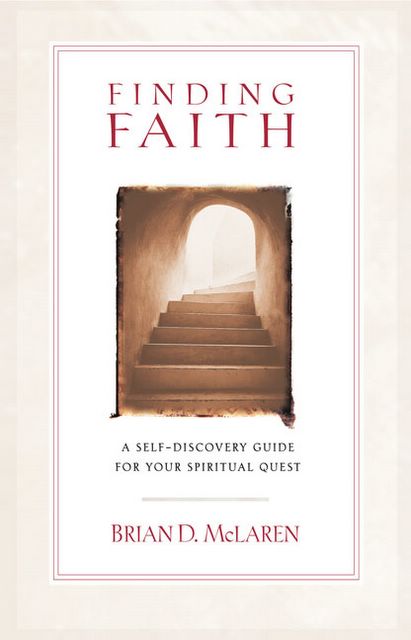
I've talked about a few Brian McLaren books in my posts. I've backed up to read one of his early one's called "Finding Faith". I'm so impressed with it that I decided to preach an eight week series on the topic. McLaren hits on a part of faith that seems to have gone untouched by other writers/speakers...how to come to faith. It's amazing that there are not more books like this but I guess that shows our "modern" mind-set (vs. a post-modern one).
The modern mind just wants the facts, thinking that the facts speak for themselves. The post-modern mind wants more. It wants context. It wants relationship. It wants to know how the "what" will play out on a daily basis. The post-modern person doesn't just believe because it's "the right thing to do". They believe because it makes their life better.
When I was a new believer I read books like "Know Why You Believe" and "Evidence that Demands a Verdict". These were books about what you need to know about Christianity, i.e. who Jesus was, what he did, why his death was important, etc. These are obviously important things but in the scheme of things, they are way down the line in the faith process. Before we can come to faith we really need to know how to believe first, then what to believe.
I'd love to hear back from my readers on where you are at in the faith process and how you got there. I haven't had much luck in getting people to post - I don't if it takes too much time or it's too intimidating to see your thoughts on-line, even though anonymous, but it would be a great discussion to hear from believers at various stages of faith and even non-believers who want to tell me why they don't have a faith.
- What are your struggles?
- What have been stumble blocks in your faith experience?
- What made it easy?
- How has it changed (or not changed) your life?
Over the past few decades, faith has been painted as very black and white in my circles. Either you are in or out with few, if any, shades of gray. But faith is a process. We are all at different points in the journey. We don't have to be ashamed of where we are at in the process. Some of us have hit a dead-end and need to back up and take another run at it. That's okay. Some times you have to tear down before you can build up.
So, let me hear from you. Take the time and the risk and let's hear what you have to say about your process of coming/not coming to faith. Thanks! I'm looking forward to hearing from you.
Wednesday, August 03, 2005
Finding True Freedom
I heard the author of the book "Smart Sex" on the radio the other day. I liked what she had to say about personal freedom. She said that the goal of everyone in our culture is to be unencumbered - that is, we seek to have as few restrictions on us as possible. We don't want anyone telling us what to do about our sex life or anything for that matter.
As I thought about that, I had to agree. Even my discussion below about casual dress is about our desire to be free of anyone telling us how to dress. We want as much personal freedom as possible with as few people telling us what to do as possible.
But the desire for personal freedom flies in the face of what it means to follow Jesus. There's not one part of our life that is "free" from the call of God. The true follower makes it their goal to give up their personal agenda/desire for personal freedom to align themselves with God's design.
The Christian message is a tough "sell" when seen in this light. Why would anyone want to give up their agenda for God's?
The answer lies in realizing what true freedom is. It is a myth to believe that we are free when we throw off all encumbrances and call all of our own shots in life. True freedom comes when we submit ourselves to someone who cares for us and knows more than we do. How free are we when we reject the care and wisdom of physicians? How free is a child when she rejects the care and wisdom of her parents? How free are we when we reject the care and wisdom of a tour guide in an unknown land? Rejecting the care of these people can lead to great pain and even death.
In the same way, throwing off the "shackles" of God is not freedom but bondage. No one cares for us more and no one is wiser than God. I fear for what people will need to experience in life before they understand this. But, unfortunately, sometimes experience is the only way we learn. Hopefully there will be someone there to help us when we "hit the wall" and start looking for a better way.
As I thought about that, I had to agree. Even my discussion below about casual dress is about our desire to be free of anyone telling us how to dress. We want as much personal freedom as possible with as few people telling us what to do as possible.
But the desire for personal freedom flies in the face of what it means to follow Jesus. There's not one part of our life that is "free" from the call of God. The true follower makes it their goal to give up their personal agenda/desire for personal freedom to align themselves with God's design.
The Christian message is a tough "sell" when seen in this light. Why would anyone want to give up their agenda for God's?
The answer lies in realizing what true freedom is. It is a myth to believe that we are free when we throw off all encumbrances and call all of our own shots in life. True freedom comes when we submit ourselves to someone who cares for us and knows more than we do. How free are we when we reject the care and wisdom of physicians? How free is a child when she rejects the care and wisdom of her parents? How free are we when we reject the care and wisdom of a tour guide in an unknown land? Rejecting the care of these people can lead to great pain and even death.
In the same way, throwing off the "shackles" of God is not freedom but bondage. No one cares for us more and no one is wiser than God. I fear for what people will need to experience in life before they understand this. But, unfortunately, sometimes experience is the only way we learn. Hopefully there will be someone there to help us when we "hit the wall" and start looking for a better way.
Tuesday, August 02, 2005
What Happens When You Die?
Someone recently wrote and asked me what the Bible says will happen when we die? Does our soul "sleep" and wait to be resurrected when Jesus returns?
I hope not! The apostle Paul said that "To be absent from the body is to be present with the Lord." I take that as meaning that when we die our spirit is released from the confines of our physical body and goes to be with God. I think we cross into a new dimension - an invisible world that we can't see but is all around us now.
Going to be with God at death causes people to wonder what happens at the final resurrection when Jesus comes back. What will be resurrected if we are already with God? The thought is that we will be given a new physical body at that time. Paul talks about that to the Corinthian church. Our soul has a new "shell", one with a different quality than the original model. ( i.e., Jesus' resurrected body was able to pass through a solid wall.)
My speculation is that we are given a new body to live on a new earth. Not only will we be changed, so will the earth. The Bible has a lot to say about how God will transform the earth when Jesus returns. Now, that introduces another question/contradiction. Some think that the earth will be destroyed and heaven is this celestial type of Wonder Land. But the Bible talks about a new earth, as in, re-newed (just like we are renewed). In other words, heaven may simply be a new earth minus the curse.
It's all beyond me, but I hope this helps a bit!
I hope not! The apostle Paul said that "To be absent from the body is to be present with the Lord." I take that as meaning that when we die our spirit is released from the confines of our physical body and goes to be with God. I think we cross into a new dimension - an invisible world that we can't see but is all around us now.
Going to be with God at death causes people to wonder what happens at the final resurrection when Jesus comes back. What will be resurrected if we are already with God? The thought is that we will be given a new physical body at that time. Paul talks about that to the Corinthian church. Our soul has a new "shell", one with a different quality than the original model. ( i.e., Jesus' resurrected body was able to pass through a solid wall.)
My speculation is that we are given a new body to live on a new earth. Not only will we be changed, so will the earth. The Bible has a lot to say about how God will transform the earth when Jesus returns. Now, that introduces another question/contradiction. Some think that the earth will be destroyed and heaven is this celestial type of Wonder Land. But the Bible talks about a new earth, as in, re-newed (just like we are renewed). In other words, heaven may simply be a new earth minus the curse.
It's all beyond me, but I hope this helps a bit!
Monday, August 01, 2005
How Casual is Too Casual?
I just heard a news report asking the question, "How Casual is Too Casual?" at work. The report talked about how people are showing up to work in flip-flops. They said that our culture has gotten very individualized...with personal phones and personal computers. It's a very "me" focused world so it's only natural that we want to dress to please ourselves and not others. But they said that we should stick to flip-flops at the beach.
I can relate to the desire to be casual. I just mentioned in church yesterday how I always try to dress as casually as I possibly can. I'd preach in flip-flops myself if I thought people would be okay with it ( I don't!). There's something about dressing down that seems to trick my mind into thinking I'm not working if I'm dressed like I'm on vacation.
I'm reminded of how my son would often go to high school in his pajama bottoms. In fact, I was in a very classy restaurant last week on vacation, and the owner came to our table with a glass of wine and pajama bottoms (thankfully he had a shirt on!). I thought it was interesting but not too strange...which is strange in itself that our culture has so quickly drifted to being so casual.
Applying all this talk to church...Cedarbrook is a super casual church. I heard someone say once about Cedarbrook that what they liked about it is that they can wear a dress or show up in their pajama bottoms and they fit in either way. I guess not too many churches can say that! But that begs the question...where is the reverance? Where is the sense of awe?
I agree that some church buildings (i.e. cathedrals, etc.) produce a sense of awe just walking into them. You won't get that at the CineMagic Theatre (where we meet for church). And some services produce a sense of awe (organ, silence, liturgy, etc). But what I like about being casual -and this is why we will always be casual - is that it reflects an approachableness. God is approachable. Many, many people don't know that. They are afraid of God, convinced that he is against them. But Jesus died so we could approach God without wincing. His death removed the unapproachableness of God. The book of Hebrews said that we can "boldly" go into his presence.
Now, we can miss the point and get too familiar. We can take God's approachableness for granted and think we can "slap God on the back" so to speak, like a good-'ol boy. It's one thing to be invited into the Oval Office to meet the President. It's another thing to put your feet up on his desk and smoke a cigar!
I guess, what I'm getting at here is that the reverance and awe that we try to manufacture in structure of service and buildings often does more damage than good. It scares people away from God. That's not a good thing. Our reverence and awe should come from within our heart when we encounter God and that can happen even in our pajama bottoms and flip-flops. Like the Bible says, God looks at our heart. He's not as concerned as we are about what's on the outside.
I can relate to the desire to be casual. I just mentioned in church yesterday how I always try to dress as casually as I possibly can. I'd preach in flip-flops myself if I thought people would be okay with it ( I don't!). There's something about dressing down that seems to trick my mind into thinking I'm not working if I'm dressed like I'm on vacation.
I'm reminded of how my son would often go to high school in his pajama bottoms. In fact, I was in a very classy restaurant last week on vacation, and the owner came to our table with a glass of wine and pajama bottoms (thankfully he had a shirt on!). I thought it was interesting but not too strange...which is strange in itself that our culture has so quickly drifted to being so casual.
Applying all this talk to church...Cedarbrook is a super casual church. I heard someone say once about Cedarbrook that what they liked about it is that they can wear a dress or show up in their pajama bottoms and they fit in either way. I guess not too many churches can say that! But that begs the question...where is the reverance? Where is the sense of awe?
I agree that some church buildings (i.e. cathedrals, etc.) produce a sense of awe just walking into them. You won't get that at the CineMagic Theatre (where we meet for church). And some services produce a sense of awe (organ, silence, liturgy, etc). But what I like about being casual -and this is why we will always be casual - is that it reflects an approachableness. God is approachable. Many, many people don't know that. They are afraid of God, convinced that he is against them. But Jesus died so we could approach God without wincing. His death removed the unapproachableness of God. The book of Hebrews said that we can "boldly" go into his presence.
Now, we can miss the point and get too familiar. We can take God's approachableness for granted and think we can "slap God on the back" so to speak, like a good-'ol boy. It's one thing to be invited into the Oval Office to meet the President. It's another thing to put your feet up on his desk and smoke a cigar!
I guess, what I'm getting at here is that the reverance and awe that we try to manufacture in structure of service and buildings often does more damage than good. It scares people away from God. That's not a good thing. Our reverence and awe should come from within our heart when we encounter God and that can happen even in our pajama bottoms and flip-flops. Like the Bible says, God looks at our heart. He's not as concerned as we are about what's on the outside.
Wednesday, July 27, 2005
Satisfaction with "Doing Church"
I told you the down side of "doing" church below. It seems like we are communicating a false impression of what both church, and a life of faith, is all about. But, having said that, I don't think that's necessarily true.
It's like having friends over for dinner. You clean your house. You clear your schedule. You serve a nice meal and maybe enjoy a movie or play some games. It's like Friendship 101. That's normal behavior but true friendship is much more than that and everyone knows it. Your friends know that you don't live like that every night. They know your house isn't always clean. They know that if they came back the next day unannounced that everything would be much different. You aren't going to drop everything and start serving them. In fact, you might put them to work!
They also know that if they wanted to get serious about being your friend that there would be much more "required" of you. You'd not only come over at their invitation but you would return the favor. Plus you'd start to share more of everyday life, like helping them move or show up at the hospital when someone is sick. And you'd share more of your heart too. Your conversations would go deeper as you share your doubts and worries about life as well as your joys.
That's exactly what happens at church. Sunday truly is a "front door" to the relationship. It's only a beginning not the end. There's nothing wrong with "entertaining guests" on Sunday but I do believe that you have to make it clear that there is much more than a one-way relationship to a life of faith. There is always a "next step" to take toward God and community. And the deeper you go the more sacrifice there is - just like in a friendship.
As I throw this out to you...what's your view of church? Maybe you avoid it because it's too shallow. Well, if you see it only as a Sunday event...yes, it IS shallow. There is much more. Or, maybe you like the shallowness of it and you enjoy being a spiritual "consumer". If that's true, there's another step for you to take - a step toward community and service - a step toward learning to not only receive but to give back. That is true worship...not putting in your "time" or singing a song or throwing a buck in the plate when it goes by, but reflecting God's giving nature by giving back to others.
The Spirit filled life is not about you - it's about others and God. And surprisingly, when you get that straight, you find that you are most satisfied and fulfilled.
It's like having friends over for dinner. You clean your house. You clear your schedule. You serve a nice meal and maybe enjoy a movie or play some games. It's like Friendship 101. That's normal behavior but true friendship is much more than that and everyone knows it. Your friends know that you don't live like that every night. They know your house isn't always clean. They know that if they came back the next day unannounced that everything would be much different. You aren't going to drop everything and start serving them. In fact, you might put them to work!
They also know that if they wanted to get serious about being your friend that there would be much more "required" of you. You'd not only come over at their invitation but you would return the favor. Plus you'd start to share more of everyday life, like helping them move or show up at the hospital when someone is sick. And you'd share more of your heart too. Your conversations would go deeper as you share your doubts and worries about life as well as your joys.
That's exactly what happens at church. Sunday truly is a "front door" to the relationship. It's only a beginning not the end. There's nothing wrong with "entertaining guests" on Sunday but I do believe that you have to make it clear that there is much more than a one-way relationship to a life of faith. There is always a "next step" to take toward God and community. And the deeper you go the more sacrifice there is - just like in a friendship.
As I throw this out to you...what's your view of church? Maybe you avoid it because it's too shallow. Well, if you see it only as a Sunday event...yes, it IS shallow. There is much more. Or, maybe you like the shallowness of it and you enjoy being a spiritual "consumer". If that's true, there's another step for you to take - a step toward community and service - a step toward learning to not only receive but to give back. That is true worship...not putting in your "time" or singing a song or throwing a buck in the plate when it goes by, but reflecting God's giving nature by giving back to others.
The Spirit filled life is not about you - it's about others and God. And surprisingly, when you get that straight, you find that you are most satisfied and fulfilled.
Tuesday, July 26, 2005
Frustrations with "Doing Church"
"Doing church" is a constant frustration for me. You don't "do" church. It's not a Sunday event. Church is a lifestyle shared with a network of people and filled with the presence of God. So every time we hold a Sunday service I feel like we are somehow undermining the very thing that we preach!
Part of being "mission" minded is communicating in the context of the people that you want to reach. The USA context is business/service oriented. People understand going to a business and getting what they want/need. If you want to reach these people it's helpful to embody the context that they understand and are comfortable with. So the modern church packages it's message in a nice one hour bundle on Sunday morning and offers free child care. How convenient. But what if that context is fundamentally a flawed vehicle for our message? What if convenience and comfort is the antithesis of our message?
What I mean is that the message of Jesus is embedded in the concept of community- of a shared life - and sacrifice. But we convey our message primarily through a one hour medium that promotes looking at the back of someone's head in the comfort of stadium seating - the very opposite of community and sacrifice. We justify that by saying that Sunday morning is only the "front door" to community life, but I wonder how convincing we are.
Of course, this frustration is not news to promoters of the House Church movement (groups of believers committed to only meeting in homes to counteract the problem I speak of) but that movement has it's own set of frustrations and limitations. More soon...
Part of being "mission" minded is communicating in the context of the people that you want to reach. The USA context is business/service oriented. People understand going to a business and getting what they want/need. If you want to reach these people it's helpful to embody the context that they understand and are comfortable with. So the modern church packages it's message in a nice one hour bundle on Sunday morning and offers free child care. How convenient. But what if that context is fundamentally a flawed vehicle for our message? What if convenience and comfort is the antithesis of our message?
What I mean is that the message of Jesus is embedded in the concept of community- of a shared life - and sacrifice. But we convey our message primarily through a one hour medium that promotes looking at the back of someone's head in the comfort of stadium seating - the very opposite of community and sacrifice. We justify that by saying that Sunday morning is only the "front door" to community life, but I wonder how convincing we are.
Of course, this frustration is not news to promoters of the House Church movement (groups of believers committed to only meeting in homes to counteract the problem I speak of) but that movement has it's own set of frustrations and limitations. More soon...
Wednesday, July 20, 2005
Radio Dialogue - Day Five
Following is the script we used for our WWIB "Reflections" program.
DAY FIVE
Remy: Welcome back for our last show where we are talking about why people don't attend church. Christine Ruth has joined me once again. Welcome, Christine.
Christine: Thanks Remy. I've enjoyed being here this week. Remy, I told you my story yesterday about why I quit going to church and explored Buddhism. What's your story?
Remy: I actually quit going to church twice. The first time was when most people quit going to church, right after confirmation! Confirmation seems to be the church equivalent to graduation. We take our classes, graduate and then move on to bigger and better things - at least that's what we think. At the time, church made no sense. God wasn't personal to me or my family, so it was a family decision.
Christine: Okay, that's one. What was the second time?
Remy; the second time was after I became a Christian and been in church for about twelve years. The church I was a part of went through a split. It really disillusioned me. I tried going back to church because I believe in the church but I could barely sit through a service. I felt sick inside.
Christine: Why was that?
Remy: Well, I gave that a lot of thought. It just all seemed so hollow. So fake. Everything being said was just words to me. I was really devastated. I had invested a lot of my life in the church and I felt betrayed. I didn't lose my faith in God but I lost a lot of faith in church people and the church as an institution. Every few months I'd try to go to church but the feeling didn't change. That went on for five years until I was finally able to settle back into the life of a church.
Christine: So Remy, after your experience and all that we've talked about this week, what's your conclusion? What is the bottome line? What do you think will bring people back to church?
Remy: Christine, I really believe that when the church preaches the good news – the news that God accepts us unconditionally and empowers us to live a new life – a transformed life - then people will come. Everyone on the planet is looking for acceptance and the power to live a transformed life. We've got the news that everyone wants to hear. When we learn how to not only proclaim it, but proclaim it in the language and the method that people can hear, then we won't have to worry about people attending church. They'll be lining up to get in.
Remy: Welcome back for our last show where we are talking about why people don't attend church. Christine Ruth has joined me once again. Welcome, Christine.
Christine: Thanks Remy. I've enjoyed being here this week. Remy, I told you my story yesterday about why I quit going to church and explored Buddhism. What's your story?
Remy: I actually quit going to church twice. The first time was when most people quit going to church, right after confirmation! Confirmation seems to be the church equivalent to graduation. We take our classes, graduate and then move on to bigger and better things - at least that's what we think. At the time, church made no sense. God wasn't personal to me or my family, so it was a family decision.
Christine: Okay, that's one. What was the second time?
Remy; the second time was after I became a Christian and been in church for about twelve years. The church I was a part of went through a split. It really disillusioned me. I tried going back to church because I believe in the church but I could barely sit through a service. I felt sick inside.
Christine: Why was that?
Remy: Well, I gave that a lot of thought. It just all seemed so hollow. So fake. Everything being said was just words to me. I was really devastated. I had invested a lot of my life in the church and I felt betrayed. I didn't lose my faith in God but I lost a lot of faith in church people and the church as an institution. Every few months I'd try to go to church but the feeling didn't change. That went on for five years until I was finally able to settle back into the life of a church.
Christine: So Remy, after your experience and all that we've talked about this week, what's your conclusion? What is the bottome line? What do you think will bring people back to church?
Remy: Christine, I really believe that when the church preaches the good news – the news that God accepts us unconditionally and empowers us to live a new life – a transformed life - then people will come. Everyone on the planet is looking for acceptance and the power to live a transformed life. We've got the news that everyone wants to hear. When we learn how to not only proclaim it, but proclaim it in the language and the method that people can hear, then we won't have to worry about people attending church. They'll be lining up to get in.
Hey, Christine, thanks for joining me this week. And thanks for all of you listeners. I hope you’ll visit us at Cedarbrook this summer.
Tuesday, July 19, 2005
Radio Dialogue - Day Four
Following is the manuscript for our WWIB "Reflections" show.
Remy; Okay, if you are joining us for the first time, I'm here with Christine Ruth and we are talking about why people don't attend church.
Christine, so far we've mentioned three reasons why people don't attend church. What are they?
Christine:
1. People want to be engaged in a discussion or conversation and not simply told what to think.
2. People are busy and use Sunday morning to either relax or work.
3. People have had a bad experience.
Remy: Well, you told me that you quit going to church for a while. Why was that? Didn't you grow up in the church?
Christine: I think another way the church has done a disservice to my generation is to somehow making us feel like once we become Christians, there’s no room left for doubt or questioning. I grew up in a committed Christian home where my parents did everything “by the book” when it came to raising us up in the faith. But when left for college, I went through a very deep period of questioning and doubt. I began studying world religions, especially Buddhism and Taoism. One day, I called home to announce to my parents that I was no longer Christian, but Buddhist!
Remy: Wow. What did they say to that? Did you blow them out of the water?
Christine: No. They did something very courageous. For the next year, they just listened to me and asked me questions without overreacting, even though I’m sure they were terrified inside. A couple years later, I recommitted myself to my Christian faith in a much deeper way.
Remy: So, do you regret that time spent in Buddhism or was it a good experience for you?
Christine: I believe that time of doubt and wrestling not only gave my faith much “stronger legs” to stand on, but it has allowed me to get into very thoughtful and empathetic discussions with many of my non-Christian friends, many of whom seem to gravitating today more towards Eastern religions than Christianity. Frederick Buechner wrote in his book, Wishful Thinking, “Whether your faith is that there is a God or that there is not a God, if you don’t have any doubts, you are either kidding yourself or asleep. Doubts are the ants in the pants of faith. They keep it awake and moving.” I think the church needs to be a place where people are committed, not to giving simple, black-and-white answers to difficult questions, but a place where we can come alongside one another as fellow pilgrims on a journey. It should be a place where doubt can open our eyes and lead us to a deeper reexamining of our beliefs.
Remy: So doubt isn’t necessarily a bad thing. I can see how God has used it in your life. Thanks for sharing that. Maybe tomorrow I'll tell my own story.
DAY FOUR
Remy; Okay, if you are joining us for the first time, I'm here with Christine Ruth and we are talking about why people don't attend church.
Christine, so far we've mentioned three reasons why people don't attend church. What are they?
Christine:
1. People want to be engaged in a discussion or conversation and not simply told what to think.
2. People are busy and use Sunday morning to either relax or work.
3. People have had a bad experience.
Remy: Well, you told me that you quit going to church for a while. Why was that? Didn't you grow up in the church?
Christine: I think another way the church has done a disservice to my generation is to somehow making us feel like once we become Christians, there’s no room left for doubt or questioning. I grew up in a committed Christian home where my parents did everything “by the book” when it came to raising us up in the faith. But when left for college, I went through a very deep period of questioning and doubt. I began studying world religions, especially Buddhism and Taoism. One day, I called home to announce to my parents that I was no longer Christian, but Buddhist!
Remy: Wow. What did they say to that? Did you blow them out of the water?
Christine: No. They did something very courageous. For the next year, they just listened to me and asked me questions without overreacting, even though I’m sure they were terrified inside. A couple years later, I recommitted myself to my Christian faith in a much deeper way.
Remy: So, do you regret that time spent in Buddhism or was it a good experience for you?
Christine: I believe that time of doubt and wrestling not only gave my faith much “stronger legs” to stand on, but it has allowed me to get into very thoughtful and empathetic discussions with many of my non-Christian friends, many of whom seem to gravitating today more towards Eastern religions than Christianity. Frederick Buechner wrote in his book, Wishful Thinking, “Whether your faith is that there is a God or that there is not a God, if you don’t have any doubts, you are either kidding yourself or asleep. Doubts are the ants in the pants of faith. They keep it awake and moving.” I think the church needs to be a place where people are committed, not to giving simple, black-and-white answers to difficult questions, but a place where we can come alongside one another as fellow pilgrims on a journey. It should be a place where doubt can open our eyes and lead us to a deeper reexamining of our beliefs.
Remy: So doubt isn’t necessarily a bad thing. I can see how God has used it in your life. Thanks for sharing that. Maybe tomorrow I'll tell my own story.
Monday, July 18, 2005
Radio Dialogue - Day Three
Following is the manuscript we used for this week's "Reflections" program on WWIB radio.
DAY THREE
Remy; Welcome to our third day of discussing why people don't attend church. Christine Ruth is my guest today, one of the teachers at Cedarbrook Church. Christine, before we started Cedarbrook Church I did a survey of the churches in Dunn County and it looked like only 25% of the people attended church on a regular basis. Isn't that amazing?
Christine: Yes. As we've been discussing the past two days, it seems like the church is losing it's audience. Remy, we've talked about this a little, but why do you think that is?
Remy: Well, you brought up a good point yesterday, that younger people like to be engaged in a conversation and not just be told what to think. I think that's key. But there are a few other reasons.
Christine: Like what?
Christine: Like what?
Remy: One is very practical. People are busier and work more hours than ever before and Sunday morning is the only time for people to kick back and relax or catch up on their to-do list. The biggest competition for any church isn't the church down the street but the Sunday morning paper and a cup of coffee. It's hard to compete with that!
Christine: So, you're saying that if the church is going to compete they have to offer something that's worth adding another thing to their schedule.
Remy: Exactly. The mature believer will go to church to worship and fellowship with other believers. But the seeker won’t go unless they can walk away with a sense that they made a connection with God and learned something practical that they can use in their life – like how to raise their kids better or how to deal with their stress. I think it’s important that we address these practical needs for people as well.
Christine: Remy, I think you do a really good job of that. It’s pretty common for me to sit around the coffee shop after church for an hour or so on Sunday with my friends just discussing the sermon. Even at my Thursday Mom’s group we are still talking about it. Okay, what’s another reason people don’t go to church?
Remy: Another reason is that people have had a bad experience with church. I can't tell you how many horror stories I've heard from people over the years. You wouldn't believe all the things that have been said and done in the name of Jesus. It just turns people off.
Christine: What are some examples?
Remy: The two biggest offenses I hear about are when churches consistently ask for money – even beg for it - or try to control the details of people’s lives. People don’t want any part of that.
Christine: Any more?
Remy: Yes, but we are out of time so let's talk about those tomorrow.
Friday, July 15, 2005
Radio Dialogue - Day Two
This is the script we used for the WWIB program (airing July 18-22).
DAY TWO
Remy: Welcome back to our discussion of Why People Don't Attend Church. I've got Christine Ruth with me, one of the teachers at Cedarbrook Church. We noted yesterday that only 20% of people in their 20's are attending church.
Christine, yesterday I quoted from Erwin McManus, another pastor who said that "the Christian faith, as we express it, is no longer a viable option" for many people. He's taking a shot at how we communicate our message - saying that people have lost interest. Why do you think that is?
Christine: I think my generation sees becoming a Christian less as an event and more as a process- a journey spanning one’s whole lifetime. I think of Martin Luther who said that baptism isn’t one-time event, but a daily process – that every day, we must, in a sense, wake up and volunteer for death, so that Christ can raise us up to new life once again.
One of the things that has surprised me on my Christian journey is the discovery that the more I study the Bible, the more I realize I know nothing – how BIG the mystery of God is. I think Scripture was inappropriately presented to me as a “how-to manual” or a “rule book” that would provide black-and-white answers to all of my questions. The trite way in which some of my Christian mentors tried to respond to my questions put God into this small little box that eventually strangled my faith. I wish church leaders were more comfortable humbly admitting that there’s a lot of paradox and mystery in Scripture and that they would feel comfortable resting in the ambiguities they find there.
Remy: I agree. As a speaker, it's a challenge to preach truth without coming across as simplistic - like – “you don't have to think about this, just believe what I say”. That approach may have worked for my generation and older, but today people want to come to their own conclusions. People today aren’t looking to be converted. They are looking for a conversation. They have their own ideas about God and they want their ideas to be respected even though they may be wrong. I don’t know if we’ve done a good job of listening to people in the church. We tend to just tell them what to think.
Christine: And I’m looking for honesty too. As a seeker, I want to know that YOU wrestle too, instead of feeling like you own the corner on the market of spiritual truth. I was taught that the Bible would answer all my questions about life. But I don’t think that’s true. It’s not that black and white. Now I realize that the Bible point me to the God who is bigger than all of my questions and promises that if I seek Him, I will find him.
Remy: Thanks Christine. Let's pick this conversation up tomorrow as we look at more reasons why people don't attend church.
Thursday, July 14, 2005
Radio Dialogue on Church
I prerecorded a radio show that will be playing next week on the local Christian radio station (WWIB). I thought you might like to "listen in" by reading the transcript. There are five two minute shows...
Remy: Welcome to Reflections. This week I'm going to be talking about Why People Don't Go to Church and to help me out I've asked one of the teachers from our church, Christine Ruth. Welcome, Christine.
Christine: Thanks, Remy. It's good to be here.
Remy: Christine, I heard some rough statistics once that said about 50% of 50 years olds attend church, 40% of 40 year olds attend church and that keeps falling to 20% of 20 year olds attend church. I don't like that trend. You're 31, from your perspective, what is it that you think the church is missing?
Christine: I think we lack authenticity. Most of my friends that grew up in the church have left it, and many of them have no church experience whatsoever. I think my generation is rebelling against what we perceive to be a very hypocritical, church that puts more emphasis on going through the motions of church life than authentically putting those beliefs into practice through the exercise of justice, compassion, and genuine community – following the Way of Jesus.
Remy: Will your friends ever come to church? Is there hope for your generation?
Christine: I think there is. The good news is that my generation (20-30 something’s) is very “spiritual”, meaning they’re very interested in the supernatural in general. I read that the spirituality section in bookstores like Barnes and Noble and Borders has tripled in the last decade. So, I think the church can build on that interest.
Remy: I read an interesting quote from Erwin McManus recently. He said...
"The biting truth is that this country is not rejecting spirituality but Christianity. The indictment that we must receive is that the Christian faith as we express it is no longer seen as a viable spiritual option. ...People are rejecting Christ because of the church!" an Unstoppable Force, p. 29
McManus said that people are rejecting Jesus because of the church! That's got to make you stop and think. What do you think of that?
Christine: The church doesn’t always preach good news. That’s why people reject it. When we preach rules or our pet doctrines or our personal agenda then we lose our audience. People stop listening and look in other places. That’s what happened in my generation.
Remy: I was also struck by another part of the McManus quote. He said that "the Christian faith, AS WE EXPRESS IT is no longer seen as a viable option". He's implying that, if we want to get our message across, we have to improve the way we communicate. Let's talk about that tomorrow.
Christine: Okay!
DAY ONE
Remy: Welcome to Reflections. This week I'm going to be talking about Why People Don't Go to Church and to help me out I've asked one of the teachers from our church, Christine Ruth. Welcome, Christine.
Christine: Thanks, Remy. It's good to be here.
Remy: Christine, I heard some rough statistics once that said about 50% of 50 years olds attend church, 40% of 40 year olds attend church and that keeps falling to 20% of 20 year olds attend church. I don't like that trend. You're 31, from your perspective, what is it that you think the church is missing?
Christine: I think we lack authenticity. Most of my friends that grew up in the church have left it, and many of them have no church experience whatsoever. I think my generation is rebelling against what we perceive to be a very hypocritical, church that puts more emphasis on going through the motions of church life than authentically putting those beliefs into practice through the exercise of justice, compassion, and genuine community – following the Way of Jesus.
Remy: Will your friends ever come to church? Is there hope for your generation?
Christine: I think there is. The good news is that my generation (20-30 something’s) is very “spiritual”, meaning they’re very interested in the supernatural in general. I read that the spirituality section in bookstores like Barnes and Noble and Borders has tripled in the last decade. So, I think the church can build on that interest.
Remy: I read an interesting quote from Erwin McManus recently. He said...
"The biting truth is that this country is not rejecting spirituality but Christianity. The indictment that we must receive is that the Christian faith as we express it is no longer seen as a viable spiritual option. ...People are rejecting Christ because of the church!" an Unstoppable Force, p. 29
McManus said that people are rejecting Jesus because of the church! That's got to make you stop and think. What do you think of that?
Christine: The church doesn’t always preach good news. That’s why people reject it. When we preach rules or our pet doctrines or our personal agenda then we lose our audience. People stop listening and look in other places. That’s what happened in my generation.
Remy: I was also struck by another part of the McManus quote. He said that "the Christian faith, AS WE EXPRESS IT is no longer seen as a viable option". He's implying that, if we want to get our message across, we have to improve the way we communicate. Let's talk about that tomorrow.
Christine: Okay!
Tuesday, July 12, 2005
The Power of Community
Wow...it's been a week since I posted. Sorry about that. I've been part -time preacher and part-time painter for the new land/house that Cedarbrook just purchased. That's the problem when your past life includes the trades (painting and wallpaper). You get to volunteer!
I'm thinking about community today for a couple of reasons. First I'm been thinking about how sharp our leadership team is. Great decision makers. High integrity. Hard workers. The down side of every great achiever is that they don't always spend the time simply relating like they should. I really believe that the long term success of Cedarbrook (or any organization) flows out of committed relationships. Relationships can flow out of work if you are working side by side. But if everyone is off doing something different, that will never lead to relationship...usually just the opposite. We've got work to do here.
I'm also thinking about community after having coffee with a friend this morning. I left our conversation so pumped - as I often do. We dream together about how God might use us. For instance, he was driving through western Wisconsin the other day (Hammond area) and saw all the new homes. His first thought was "Cedarbrook should plant a church here!" That challenged me because I really believe that we DO need to be starting another church. It's just so easy to get bogged down in the day to day work.
My point is, I need people like that in my life to keep me moving in the right direction. So do you! Without them we get comfortable - even lazy. We pat ourselves on the back for what we've done and forget to look forward at the new risk that God wants us to take.
So - where are you in all this? How is your circle of community? Or is it just you and the dog? Maybe you can do something about that.
I'm thinking about community today for a couple of reasons. First I'm been thinking about how sharp our leadership team is. Great decision makers. High integrity. Hard workers. The down side of every great achiever is that they don't always spend the time simply relating like they should. I really believe that the long term success of Cedarbrook (or any organization) flows out of committed relationships. Relationships can flow out of work if you are working side by side. But if everyone is off doing something different, that will never lead to relationship...usually just the opposite. We've got work to do here.
I'm also thinking about community after having coffee with a friend this morning. I left our conversation so pumped - as I often do. We dream together about how God might use us. For instance, he was driving through western Wisconsin the other day (Hammond area) and saw all the new homes. His first thought was "Cedarbrook should plant a church here!" That challenged me because I really believe that we DO need to be starting another church. It's just so easy to get bogged down in the day to day work.
My point is, I need people like that in my life to keep me moving in the right direction. So do you! Without them we get comfortable - even lazy. We pat ourselves on the back for what we've done and forget to look forward at the new risk that God wants us to take.
So - where are you in all this? How is your circle of community? Or is it just you and the dog? Maybe you can do something about that.
Tuesday, July 05, 2005
More on Simplicity
Thanks to Daniel for his comments in the post below.
I listened to a radio show yesterday talking about "Intelligent Design". The person being interviewed (Dr. Hugh Ross) was a Christian believer who believed in an "old" earth (vs. a 6,000 year old earth like some Christians believe). It was an interesting discussion. But there were some callers who were very resistant to the idea of an old earth. You could hear in their voice that their faith was threatened by this man and they needed to defend it.
I thought the discussion was a good example of how believers often complicate faith and thus, make it exclusive and irrelevant. If I was a non-believer listening, I'd think... "This is an interesting discussion - all these different ideas about how the earth was created, by Whom and when. Hmmmm, I never thought about that. I wonder what role God - if there is one -played in all of this." But as soon as the faith defenders called in my attitude would change. No longer is it a discussion, it's fearful people wanting everyone to think like them to make THEM comfortable. They don't want their world shaken. They don't want any variables, just absolutes. That would turn me off and make me change the channel.
When believers make things complicated, unbelievers check out. They don't want to be a part of the pettiness (and neither do I!). I think that's why the apostle Paul said that he kept things simple...he focused on preaching "Christ and him crucified" (in 1 Corinthians 1). He was saying that we don't need to add things to our message to make it interesting. Jesus died to bring us into a fresh relationship with God. Period. It doesn't get any better than that. Don't jazz it up. Don't dilute it with your personal agenda, i.e. when the earth was created, once saved always saved theology, end times speculation, gifts of the Spirit controversies, etc. etc. Just enjoy God and share this news with others. If you want to explore how the world was created, etc. knock yourself out. But don't confuse these issues with the message of "Christ and him crucified." You'll do more damage than good.
I listened to a radio show yesterday talking about "Intelligent Design". The person being interviewed (Dr. Hugh Ross) was a Christian believer who believed in an "old" earth (vs. a 6,000 year old earth like some Christians believe). It was an interesting discussion. But there were some callers who were very resistant to the idea of an old earth. You could hear in their voice that their faith was threatened by this man and they needed to defend it.
I thought the discussion was a good example of how believers often complicate faith and thus, make it exclusive and irrelevant. If I was a non-believer listening, I'd think... "This is an interesting discussion - all these different ideas about how the earth was created, by Whom and when. Hmmmm, I never thought about that. I wonder what role God - if there is one -played in all of this." But as soon as the faith defenders called in my attitude would change. No longer is it a discussion, it's fearful people wanting everyone to think like them to make THEM comfortable. They don't want their world shaken. They don't want any variables, just absolutes. That would turn me off and make me change the channel.
When believers make things complicated, unbelievers check out. They don't want to be a part of the pettiness (and neither do I!). I think that's why the apostle Paul said that he kept things simple...he focused on preaching "Christ and him crucified" (in 1 Corinthians 1). He was saying that we don't need to add things to our message to make it interesting. Jesus died to bring us into a fresh relationship with God. Period. It doesn't get any better than that. Don't jazz it up. Don't dilute it with your personal agenda, i.e. when the earth was created, once saved always saved theology, end times speculation, gifts of the Spirit controversies, etc. etc. Just enjoy God and share this news with others. If you want to explore how the world was created, etc. knock yourself out. But don't confuse these issues with the message of "Christ and him crucified." You'll do more damage than good.
Sunday, July 03, 2005
Simple or Simplistic?
When I was 19 and a new believer, I remember having a conversation with my mom. She was disappointed that I had become like the "Baptists" from her home town. She saw them as being simplistic in their faith.
I remember defending my new faith to her. God wasn't complicated. He made connecting with him simple so no one would be left out.
Now, years later, I see that my mom and I were talking about two totally different things and we were both right. God has made faith simple. You don't have to climb a mountain or memorize a book to connect with God. The Bible says that our connection with God is as close as the word on our lips. When we invite God into relationship, he's there. In fact, he invited us first. He's just waiting for us to respond. It really is that simple. Jesus did the work and we receive the benefit of his work.
But although faith is simple, it's not simplistic. A simple faith does not reduce the problems of the world to cute cliches or sound bites. I think that's what my mom objected to - when someone became "born again" they seemed to lose the ability to reason and wrestle with issues intellectually. Suddenly, all of life's questions were boiled down to quoting the right Bible verse. You didn't have to think anymore, just get a good Bible reference to give you the right quote. It's no wonder my mom - someone who enjoys thinking things through - objected to what she saw in her home town Baptists.
But God never intended for us to commit intellectual suicide by being born again. In fact, when God's Spirit enters your life He should make your intellectual side come alive. He will give birth to new thoughts and new ways of thinking.
It's sad that believers often are guilty of checking their brains at the door of faith. I don't know where that came from but it's not what it means to follow Jesus.
I remember defending my new faith to her. God wasn't complicated. He made connecting with him simple so no one would be left out.
Now, years later, I see that my mom and I were talking about two totally different things and we were both right. God has made faith simple. You don't have to climb a mountain or memorize a book to connect with God. The Bible says that our connection with God is as close as the word on our lips. When we invite God into relationship, he's there. In fact, he invited us first. He's just waiting for us to respond. It really is that simple. Jesus did the work and we receive the benefit of his work.
But although faith is simple, it's not simplistic. A simple faith does not reduce the problems of the world to cute cliches or sound bites. I think that's what my mom objected to - when someone became "born again" they seemed to lose the ability to reason and wrestle with issues intellectually. Suddenly, all of life's questions were boiled down to quoting the right Bible verse. You didn't have to think anymore, just get a good Bible reference to give you the right quote. It's no wonder my mom - someone who enjoys thinking things through - objected to what she saw in her home town Baptists.
But God never intended for us to commit intellectual suicide by being born again. In fact, when God's Spirit enters your life He should make your intellectual side come alive. He will give birth to new thoughts and new ways of thinking.
It's sad that believers often are guilty of checking their brains at the door of faith. I don't know where that came from but it's not what it means to follow Jesus.
Monday, June 27, 2005
The Mystery of Baptism
Our church baptized 25 people last night at our local town pool. This is the fourth time we've done it, baptizing almost 100 people total. Every time we hold a baptism it's always such a special night.
For those of you who think in terms of baptizing infants, that's not what we do. We are baptizing people old enough to make a decision to follow Jesus. The youngest person we baptized last night was seven. There were a few teenagers and then the rest were adults.
The more people I baptize the more I appreciate what it's all about. I think many people see baptism as an odd ritual - archaic, irrelevant. Grown people getting dunked in a pool of water. What kind of God would require such a silly thing?
But I'm seeing more and more what a powerful symbol it is. It transgresses time and culture. It's something that every person can relate to no matter what their language or what era of time they lived. Baptism is a simple "drama" that depicts both cleansing and new life. The water is a place of both birth and death so it's no wonder that God established the ritual to express these two aspects of faith. When a person is baptized they are following in the steps of not only Jesus but millions of people who have committed their life to him throughout the centuries.
I'm always amazed at the enthusiasm that people express when they decide to be baptized as well as during their baptism and after it's over. It's definitely a spiritual "high" for them. I'm also surprised by how strongly they feel God spoke to them to do it. I recently gave a message about baptism and, I'm not sure what, but something I said really grabbed people and impressed upon them that this was something they needed to do. You can download the message: Connecting with God's Story - through Baptism here. Let me know what you think.
For those of you who think in terms of baptizing infants, that's not what we do. We are baptizing people old enough to make a decision to follow Jesus. The youngest person we baptized last night was seven. There were a few teenagers and then the rest were adults.
The more people I baptize the more I appreciate what it's all about. I think many people see baptism as an odd ritual - archaic, irrelevant. Grown people getting dunked in a pool of water. What kind of God would require such a silly thing?
But I'm seeing more and more what a powerful symbol it is. It transgresses time and culture. It's something that every person can relate to no matter what their language or what era of time they lived. Baptism is a simple "drama" that depicts both cleansing and new life. The water is a place of both birth and death so it's no wonder that God established the ritual to express these two aspects of faith. When a person is baptized they are following in the steps of not only Jesus but millions of people who have committed their life to him throughout the centuries.
I'm always amazed at the enthusiasm that people express when they decide to be baptized as well as during their baptism and after it's over. It's definitely a spiritual "high" for them. I'm also surprised by how strongly they feel God spoke to them to do it. I recently gave a message about baptism and, I'm not sure what, but something I said really grabbed people and impressed upon them that this was something they needed to do. You can download the message: Connecting with God's Story - through Baptism here. Let me know what you think.
Wednesday, June 22, 2005
Runaway Bride
Did you catch the TV interview with the "Runaway Bride" on Tuesday night? She was the woman in Atlanta who took off on a bus 4 days before her wedding and then made up a story about being abducted. Katie Couric interviewed her.
I found it interesting. Couric was trying to get an answer to how she could do something like that. How could she hurt her loved ones so much? She said that many people think she did it for the notoriety and to make money. That's amazing to me that people would suggest that.
The truth is...to some extent we are all "runaway brides". We all have things that we can't face, things that put us over the top. Either these things aren't as dramatic or newsworthy as this woman's or we haven't yet faced the predicament that will put us over the top. But can you imagine all of the major networks swarming your house at the exact moment you had your life's most embarrassing moment... the mental lapse, the moral failure, the fit of rage?
I can't judge her. I feel sorry for her. She admits that she's a perfectionist. She's a driven person. There's something inside of her that needs affirming - that needs validation. All her life she sought to feel worthy by being the perfect little girl...and then the perfect adult woman. She was going to have the perfect wedding - 600 people. But this event put her over the top. She couldn't do it. The fear of failure, of being exposed as a phony- as incompetent- was too much to bear.
You see, when you reach your breaking point you aren't thinking about anything but survival. You aren't thinking about your poor fiance or family or returning 600 gifts. It's like a panic attack. Your world closes in and you just want out. The woman said that it was either she take the bus ride or take a bottle of pills to end it all.
I'm writing about this because I want people to have more compassion for each other. We all have hurts. We all have weaknesses - flaws. That's the human condition. It shouldn't surprise us. We know it's true in ourselves. Why are we so quick to attack others when their flaw is revealed? Tomorrow could be the day that we hit the wall. Don't we want people there to catch us when we fall? The Bible tells us...
1Brothers, if someone is caught in a sin, you who are spiritual should restore him gently. But watch yourself, or you also may be tempted. 2Carry each other's burdens, and in this way you will fulfill the law of Christ. 3If anyone thinks he is something when he is nothing, he deceives himself. Galatians 6
I found it interesting. Couric was trying to get an answer to how she could do something like that. How could she hurt her loved ones so much? She said that many people think she did it for the notoriety and to make money. That's amazing to me that people would suggest that.
The truth is...to some extent we are all "runaway brides". We all have things that we can't face, things that put us over the top. Either these things aren't as dramatic or newsworthy as this woman's or we haven't yet faced the predicament that will put us over the top. But can you imagine all of the major networks swarming your house at the exact moment you had your life's most embarrassing moment... the mental lapse, the moral failure, the fit of rage?
I can't judge her. I feel sorry for her. She admits that she's a perfectionist. She's a driven person. There's something inside of her that needs affirming - that needs validation. All her life she sought to feel worthy by being the perfect little girl...and then the perfect adult woman. She was going to have the perfect wedding - 600 people. But this event put her over the top. She couldn't do it. The fear of failure, of being exposed as a phony- as incompetent- was too much to bear.
You see, when you reach your breaking point you aren't thinking about anything but survival. You aren't thinking about your poor fiance or family or returning 600 gifts. It's like a panic attack. Your world closes in and you just want out. The woman said that it was either she take the bus ride or take a bottle of pills to end it all.
I'm writing about this because I want people to have more compassion for each other. We all have hurts. We all have weaknesses - flaws. That's the human condition. It shouldn't surprise us. We know it's true in ourselves. Why are we so quick to attack others when their flaw is revealed? Tomorrow could be the day that we hit the wall. Don't we want people there to catch us when we fall? The Bible tells us...
1Brothers, if someone is caught in a sin, you who are spiritual should restore him gently. But watch yourself, or you also may be tempted. 2Carry each other's burdens, and in this way you will fulfill the law of Christ. 3If anyone thinks he is something when he is nothing, he deceives himself. Galatians 6
Monday, June 20, 2005
Adventures in Missing the Point
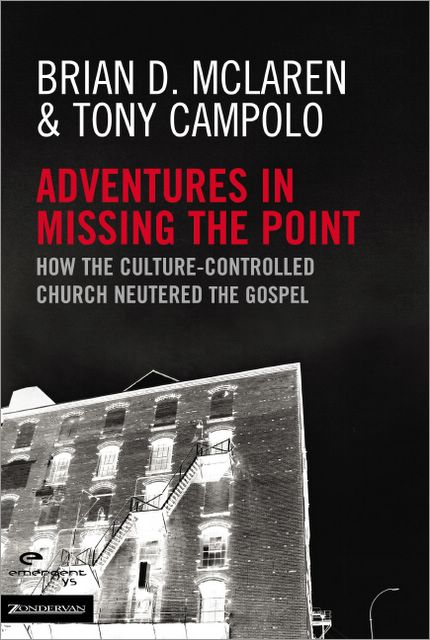

I'm on to another McLaren book...Adventures in Missing the Point: how the culture-controlled church neutured the gospel. I would subtitle it...Why we always seem to ask the wrong question.
Unlike the McLaren triology (see post below) this book takes a more direct approach to rethinking the Christian faith. Plus, it includes Tony Campolo. Tony and McLaren share chapter writings and then each comment on each other's thoughts. It's a good primer for the things that were touched on in A New Kind of Christian.
Tony and Brian rethink everthing from the Bible, to salvation, to the end times, to women in ministry, to the environment and more. I think it's very helpful to hear these two respected pastors/theologians talk about issues that many people think are pure black and white. In reality, there is a range of thought in Christendom and I find it helpful to hear it all, not just one version.
I was discussing this book with a few others last week and we noted how much more intertested people seem to be in the Christian message if it's not presented it in such black and white - "all or nothing" ways. As I've written before, no one likes things crammed down their throat. When we sense people have an agenda (and that agenda involves us!) we naturally back away. This book softens the edges of the faith and helps people find an entry point to it.
Subscribe to:
Posts (Atom)